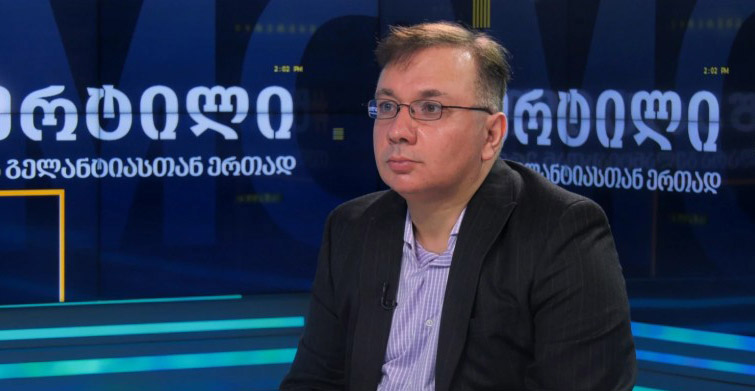
Nino Kalandadze | Ilia Chavchavadze Center for European Studies and Civic Education
This article represents independent academic and policy analysis based on publicly available sources.
Georgia’s democratic backsliding is not merely a domestic affair. Russia’s full-scale invasion of Ukraine has revealed how deeply Moscow’s strategic calculus depends on keeping Georgia – a critical node in European energy and trade architecture – outside Western orbit. The EU can no longer treat its South Caucasus candidate as a peripheral problem.
Russia's full-scale invasion of Ukraine shattered more than a ceasefire line. It exposed the depth of Moscow's ambitions and accelerated the realignment of countries that had previously appeared stable — if fragile — on Europe's periphery. Georgia is a case in point.
A nation of 3.7 million at the crossroads of Europe, Russia, Central Asia and the Middle East, Georgia has pursued Euro-Atlantic integration since regaining independence in 1991. As a founding member of the Eastern Partnership (EaP) — launched in 2009 and the primary framework through which the EU has channelled over €14.5 billion in investments and support to its Eastern neighbours — Georgia long represented one of the EaP's most symbolically significant cases.¹ In December 2023, it was granted EU candidate status. Yet in the years since Russia's invasion, Georgia has undergone one of the most consequential political transformations in its post-Soviet history — not toward Europe, but away from it.
Recent legislative measures — including laws modelled closely on Russian-style 'foreign agents' frameworks — have significantly narrowed civic space. Independent media and universities are under pressure. The political opposition faces systematic legal harassment. The European Commission's 2025 Enlargement Report, published on 4 November, documented what it described as 'state capture' and 'judicial capture,' concluding starkly that Georgia is now 'a candidate country in name only.'²
What had been strategic ambiguity in Georgia's foreign policy has been replaced by explicit anti-Western rhetoric. Bilateral assistance from the European Commission to Georgian authorities has been suspended since June 2024. Disinformation, securitised narratives, and confrontational postures toward EU institutions have intensified — yet European support for Georgian civil society continues, reflecting the distinction that has hardened between the Georgian people and their current government.³
The objectives of the current political course in Georgia appear to include the consolidation of centralised power within an increasingly closed governance structure, the reduction of Western institutional leverage, the weakening of independent oversight mechanisms, and the reorientation of foreign policy toward what might be described as 'strategic non-Western alignment.' The long-term political and economic security of the ruling formation appears to be the animating interest.
Given the abrupt nature of this foreign policy recalibration — and the structural importance of the EU as Georgia's largest trading partner and source of financial and technical support — multiple European security analysts have concluded that this shift is unlikely to reflect purely autonomous domestic calculations. The transformation coincides with Moscow's intensified anti-Western posture, its strategic assertiveness across the South Caucasus, and documented economic and personal linkages between Georgia's dominant political formation and Russian interests. Whether the alignment is coordinated or convergent, the objective overlap between Georgia's current trajectory and Moscow's regional strategic interests has been noted across a broad range of policy research — from the German Marshall Fund to RAND to the LSE Ideas Strategic Update of July 2025.
Moscow does not require formal annexation or overt control of Tbilisi. A politically constrained, Western-detached Georgia serves multiple Russian objectives at significantly lower cost. Three domains are of particular strategic importance.
The first is the Trans-Caspian International Transport Route (TITR), widely known as the Middle Corridor — a multimodal freight network connecting China to Europe via Kazakhstan, the Caspian Sea, Azerbaijan, Georgia and Turkey. Since Russia's full-scale invasion of Ukraine, the corridor has emerged as the principal overland alternative to Russian transit routes: cargo volumes grew by 63 percent in the first eleven months of 2024, reaching 4.1 million tons.⁴ The European Commission, through its Global Gateway initiative, has committed €10 billion in investment to the corridor's development. European Commissioner for Enlargement Marta Kos described the corridor as a strategic priority for Europe's supply-chain resilience.⁵ Georgia is an indispensable node. Limiting Western engagement in Tbilisi slows corridor expansion and preserves Russia's structural relevance in Eurasian trade flows.
The second domain is energy. Georgia is essential for non-Russian energy transit to Europe through the Baku–Tbilisi–Ceyhan pipeline and the South Caucasus Pipeline. A Western-aligned Georgia reinforces Europe's diversification strategy. A politically uncertain or Russia-accommodating Georgia undermines confidence in alternative routes — indirectly reinforcing Russia's leverage over European energy supply.
The third is the Anaklia Deep-Sea Port, arguably the most consequential single infrastructure decision in Georgia's recent history. In May 2024, Georgia awarded the Anaklia contract to a Chinese-Singaporean consortium dominated by China Communications Construction Company (CCCC) — a state-owned firm on the US Treasury's non-SDN restricted list — following a tender in which no Western investor submitted a final bid. Construction has begun, though the formal contract remains unsigned.⁶ Described by the German Marshall Fund as 'the crown jewel of the Middle Corridor,' a fully operational Anaklia would transform Georgia into a major logistics hub capable of receiving large container vessels currently unable to dock in the country, and would deepen investment in the corridor.⁷ Analysts across European and American security institutions have observed that the displacement of Western strategic participation from Anaklia — and its replacement by a Chinese state actor whose principal shareholder operates within the framework of the China–Russia no-limits partnership — reduces the corridor's Western anchor in ways that coincide with Moscow's regional objectives, regardless of intent.
Georgia's strategic significance extends beyond its borders. Russia's influence in Armenia and Azerbaijan — once the defining feature of South Caucasus geopolitics — has weakened substantially since 2022. Moscow's failure to defend Armenian interests during the 2023 Azerbaijani reconquest of Nagorno-Karabakh destroyed its credibility in Yerevan; the downing of an Azerbaijani civilian aircraft by Russian air defences in December 2024 severely damaged relations with Baku. In August 2025, the United States brokered a peace framework between Armenia and Azerbaijan — the first time a Western actor, rather than Russia, successfully mediated between the two countries.⁸
In this context, Georgia's authoritarianism has become, as one recent RAND analysis noted, 'Russia's unexpected and easy win in the region.'⁹ With Armenia pivoting westward, Azerbaijan asserting strategic autonomy, and both countries deepening ties with China and the West simultaneously, maintaining influence in Tbilisi is one of Moscow's remaining structural advantages in the South Caucasus. Georgia serves as a key transit corridor, a geographic connector, and — if retained within Russia's orbit — a counterweight to the regional drift away from Moscow. A Western-integrated Georgia would accelerate that drift; a captured one slows it.
The implications for European security are structural. If the current trajectory continues, the EU risks losing a strategic transit partner, seeing energy diversification weaken, and watching democratic regression become normalised on its doorstep. The European Parliament has passed resolutions calling for targeted personal sanctions against Georgian officials responsible for democratic backsliding and for new internationally monitored elections; the effectiveness and appropriate scope of such instruments remain subject to ongoing debate within EU institutions.¹⁰
Three areas merit sustained analytical attention. First, the differentiated instruments available under the EaP framework — direct support to civil society, independent media and universities on one hand, and the suspension of bilateral assistance to authorities that has been in place since June 2024 on the other — represent the architecture the EU itself designed precisely for situations where government and society diverge. How this distinction is operationalised will determine whether EaP engagement retains meaning in the Georgian context. The post-2020 EaP framework explicitly anticipates this scenario.
Second, Anaklia's trajectory warrants close attention as a bellwether for Georgia's integration into European connectivity architecture. The strategic rationale for Western engagement with the port has not disappeared; what has changed is the governance context. Whether alternative pathways for Western participation — potentially through EBRD or EIB instruments — remain viable, and whether port-related considerations can be factored into future EU-Georgia trade and investment discussions, are questions that European institutions are actively examining.
Third, the regional dynamics argue against strategic disengagement from Georgia. With Armenia and Azerbaijan both reorienting their foreign policies in ways that create new openings for Western engagement, and with the US-brokered TRIPP framework establishing new connectivity architecture across the South Caucasus, a Georgia left outside that emerging regional architecture would represent a structural gap.¹¹ The EU's 2025 Black Sea Strategy and Global Gateway investments are designed for a region of which Georgia is a geographic and logistical cornerstone.
What Russia could only partially achieve through the occupation of Abkhazia and South Ossetia, it now secures more effectively through political leverage in Tbilisi. By influencing a Georgian ruling formation, Moscow preserves a strategic instrument that enables it to hold the wider region in place. If Russia succeeds in consolidating that influence in the aftermath of Ukraine, it will retain the capacity to disrupt trade corridors, fragment regional connectivity, and preserve its structural weight in Eurasian geopolitics at minimal cost.
Georgia matters to Europe not only because its people — who consistently show overwhelming support for EU membership — deserve support. It matters because without a stable South Caucasus, Europe faces a permanent structural vulnerability in its energy, trade and security architecture. In this contest, the adversary is not merely a narrow governing formation in Tbilisi. It is Russia itself. Moscow has long understood this. The EU cannot afford not to.
¹ European External Action Service, 'Eastern Partnership,' https://www.eeas.europa.eu/eeas/eastern-partnership_en; EU Neighbours East, 'EU Policy,' https://euneighbourseast.eu/policy/ (€14.5bn figure as of 1 January 2025).
² European Commission, '2025 Communication on EU Enlargement Policy — Extract on Georgia,' EEAS, 4 November 2025, https://www.eeas.europa.eu/delegations/georgia/2025-communication-eu-enlargement-policy-extract-about-georgia_en.
³ European Commission, 'Georgia — Enlargement and Eastern Neighbourhood,' https://enlargement.ec.europa.eu/european-neighbourhood-policy/countries-region/georgia_en.
⁴ Geopolitical Monitor, 'The Middle Corridor: A Route Born of the New Eurasian Geopolitics,' January 2025, https://www.geopoliticalmonitor.com/the-middle-corridor-a-route-born-of-the-new-eurasian-geopolitics.
⁵ Euronews, 'New Investments Push Trans-Caspian Corridor into Its Next Phase,' 1 December 2025, https://www.euronews.com/business/2025/12/01/new-investments-push-trans-caspian-corridor-into-its-next-phase.
⁶ OC Media, 'Can China Revive Georgia's Long-Stalled Anaklia Port, and at What Cost?,' October 2025, https://oc-media.org/can-china-revive-georgias-long-stalled-anaklia-port-and-at-what-cost; Ports Europe, Anaklia archive, https://www.portseurope.com/category/ports/anaklia.
⁷ RFE/RL, 'The Controversial Chinese Firms That Will Build Georgia's Black Sea Megaproject,' 31 May 2024, https://www.rferl.org/a/anaklia-china-georgia-companies-port/32974215.html (Vlahutin quote).
⁸ RAND, 'What Prospects for Lasting Peace Between Armenia and Azerbaijan?,' January 2026, https://www.rand.org/pubs/commentary/2026/01/what-prospects-for-lasting-peace-between-armenia-and-azerbaijan.html; Geopolitical Monitor, 'Trump Armenia–Azerbaijan Deal,' August 2025, https://www.geopoliticalmonitor.com/trump-armenia-azerbaijan-deal-eroding-russias-influence-in-the-south-caucasus.
⁹ GIS Reports, 'New Realities Taking Shape in Eurasia,' October 2025, https://www.gisreportsonline.com/r/new-realities-in-eurasia; German Marshall Fund, 'Who Will Fill the Strategic Gap in the South Caucasus?,' https://www.gmfus.org/news/who-will-fill-strategic-gap-south-caucasus; LSE IDEAS, 'The Changing Face of the South Caucasus,' Strategic Update, July 2025, https://www.lse.ac.uk/ideas/Assets/Documents/updates/2025-SU-SCaucasus-WEB-03.pdf.
¹⁰ European Parliament, 'Parliament Deplores the Democratic Backsliding and Repression in Georgia,' September 2025, https://www.europarl.europa.eu/news/en/press-room/20250704IPR29451; Joint Motion for Resolution RC-B10-0106/2025.
¹¹ GIS Reports, 'New Realities Taking Shape in Eurasia'; RUSI, 'Seizing the Moment: Western Opportunities Amid Change in the South Caucasus,' https://www.rusi.org/explore-our-research/publications/commentary/seizing-moment-western-opportunities-amid-change-south-caucasus.